Ceiling painting cost in Toronto
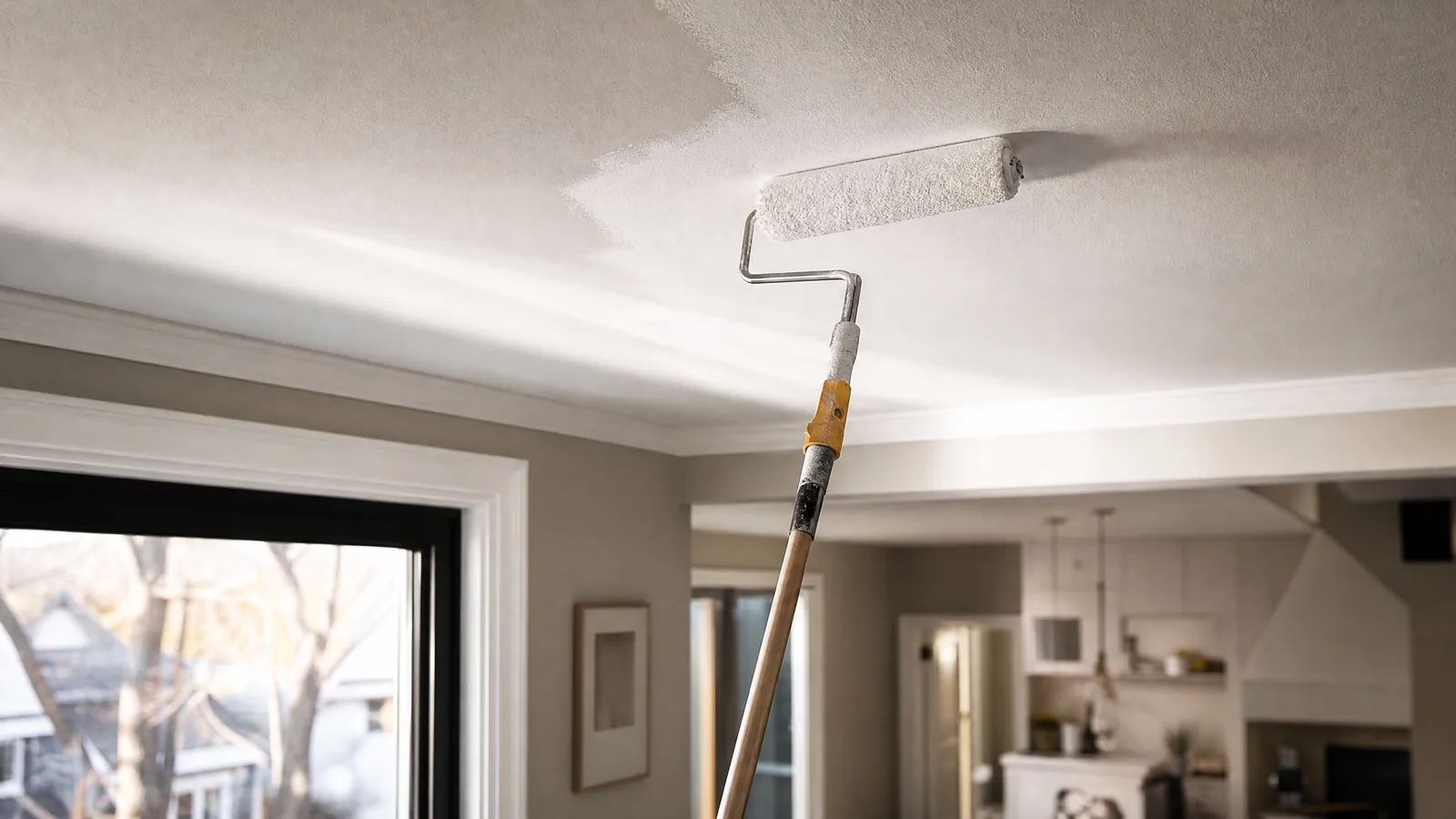
Ceiling painting in Toronto runs $1.30 to $2.00 per square foot of ceiling area (CAD, before HST), for two coats, labour and standard prep, paint extra. Ceiling area equals your floor area, so a 900 sq ft main floor is roughly $1,150 to $1,800 at a standard 8 ft height. Height, stairwells and water stains are what move that number, sometimes substantially.
The rate and what it assumes
The $1.30 to $2.00 range assumes a flat drywall or smooth plaster ceiling in sound condition, painted with two coats of ceiling paint by an insured crew that covers your floors and furniture, cuts a clean line at the wall, and cleans up. It does not include repairs, popcorn removal, or the paint itself.
Ceilings sit slightly below the wall rate of $1.40 to $2.20 per square foot, because a ceiling is one continuous plane with fewer cut ins and no outlets or baseboard to work around. What it costs you instead is neck strain, ladder moves and a far less forgiving surface: every roller lap and every missed spot shows under daylight from a window.
Ceiling area is simply your floor area
This is the one painting measurement that needs no conversion. A 12 x 12 bedroom is 144 sq ft of floor and 144 sq ft of ceiling. If you know your square footage, you already know your ceiling area.
Our estimator uses these room presets when someone counts rooms instead of measuring:
| Room | Floor and ceiling sq ft | Ceiling at $1.30 to $2.00 |
|---|---|---|
| Small (bedroom, office, under 10 x 10) | 100 | $130 to $200 |
| Medium (12 x 12 bedroom, dining room) | 150 | $200 to $300 |
| Large (living room, primary bedroom) | 220 | $300 to $450 |
| Open plan (kitchen and living together) | 400 | $500 to $800 |
Two practical notes on those numbers. First, most crews will not book a job under about $450, so a single bedroom ceiling on its own almost never gets done at the table price. It gets bundled with walls, with other rooms, or priced as a half day. Second, ceilings are far cheaper to do while the walls are being painted, because the protection, ladders and masking are already in place.
Whole floor examples
A 900 sq ft main floor at 8 ft ceilings: 900 x $1.30 to $2.00 gives roughly $1,150 to $1,800.
Now apply the height multipliers from our rate table. They apply to the whole ceiling price, because higher ceilings mean taller ladders, more setup, more moves and more time per square foot.
| Ceiling height | Factor | 900 sq ft ceiling |
|---|---|---|
| 8 ft (standard) | 1.00 | $1,150 to $1,800 |
| 9 ft | 1.10 | $1,300 to $2,000 |
| 10 ft | 1.22 | $1,450 to $2,200 |
| Over 10 ft, vaulted or stairwell | 1.40 | $1,650 to $2,500 |
Nine and ten foot ceilings are common in Toronto's older semis and Victorians, and in newer builds that advertise them as a feature. If you live in a downtown Victorian with original plaster and 10 ft ceilings, use the 1.22 row, not the 1.00 row.
A downtown address in an M4, M5 or M6 postal code adds a further 1.06 area factor in our rates. On the 900 sq ft ceiling at 9 ft, that takes it to roughly $1,400 to $2,150.
To see ceilings priced alongside walls and trim for the same rooms, run your numbers through the free estimator or read our interior painting cost per square foot guide.
Vaulted ceilings and open to above spaces
Anything over 10 ft carries the 1.40 factor. That covers vaulted and cathedral ceilings, open to above great rooms, and hard loft conversions with exposed structure.
A 400 sq ft open plan area with a vaulted ceiling: 400 x $1.30 to $2.00 is $520 to $800, times 1.40, giving about $750 to $1,100.
The extra is not paint, it is access. A vaulted ceiling usually needs scaffold, a multi position ladder, or a pole setup that is slower and less precise than standing on a six foot ladder. Cutting the line where a vaulted ceiling meets a wall at an angle is skilled work, and it looks bad forever if it is done carelessly.
Stairwells are their own problem
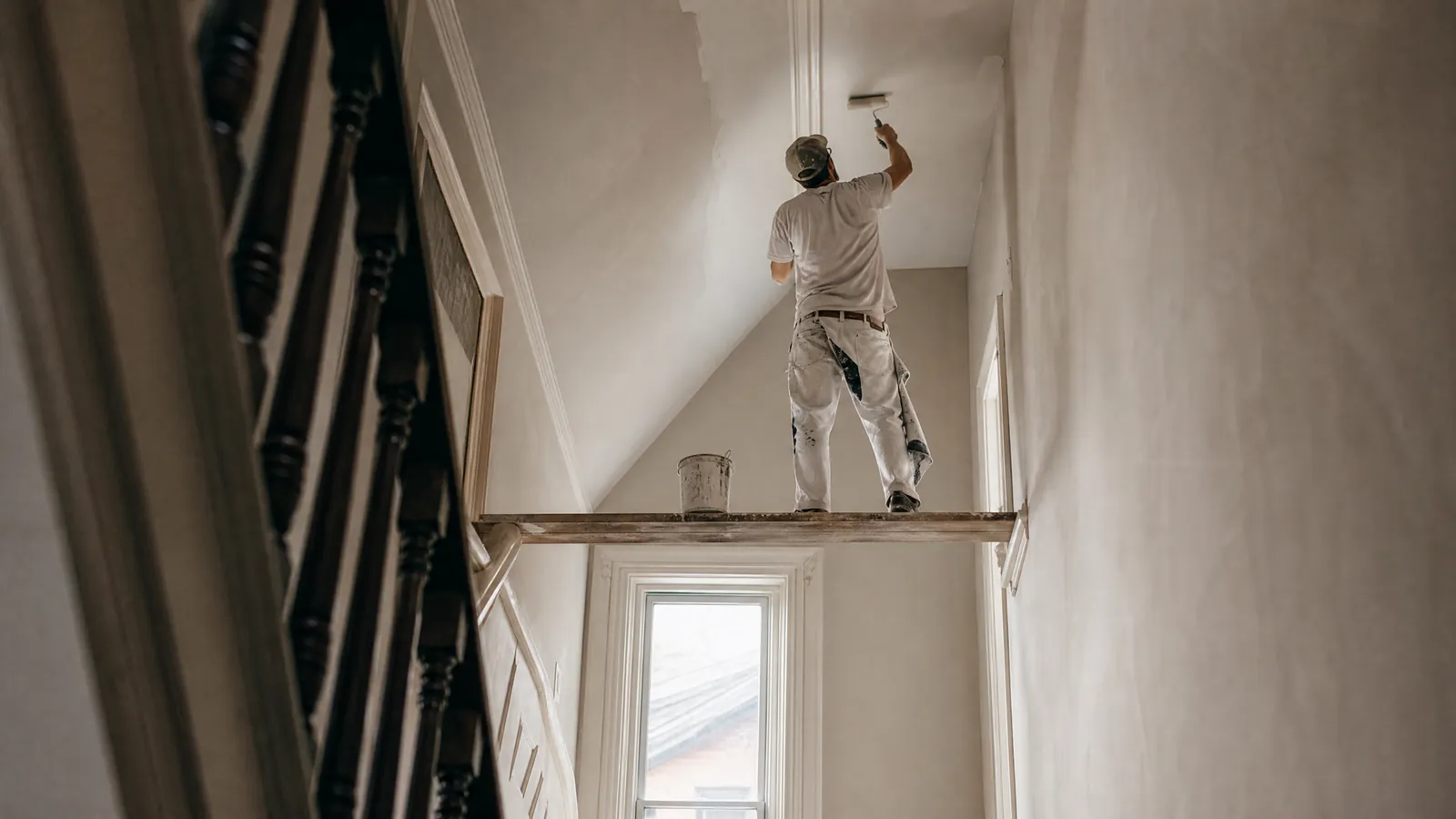
A stairwell ceiling and the wall above the stairs carry the same 1.40 factor, and for good reason. There is no flat floor to stand on. The crew is working off a ladder levelling jack, a stair platform, or scaffolding built over the treads, and every setup takes time.
Two things to keep straight when you read a quote:
- The ceiling and wall area in the stairwell is priced by square foot with the 1.40 factor applied.
- The staircase itself is a separate line item, $600 to $1,200, covering spindles, stringers and railings but not the treads.
Those are different scopes. If your quote has one number for "stairs", ask which one it means.
Water stains and why the primer matters
Toronto ceilings collect stains. An upstairs bathroom that overflowed once, an old roof leak in a semi, a radiator that wept in an apartment building, a chimney flashing that failed in a freeze thaw cycle. The stain itself is often decades old and the leak long fixed.
Painting straight over it does not work. Water stains are tannin and mineral deposits that bleed through waterborne ceiling paint, sometimes within hours, sometimes over a few weeks as they reappear in yellowish rings. The fix is a stain blocking primer, shellac based or a dedicated waterborne stain blocker, spot applied over the stain or rolled over the whole ceiling if the staining is widespread.
Primer runs $35 to $55 per can in our materials table, and a can goes a long way on spot work. It is one of the cheapest insurance policies in painting.
Heavier damage moves the whole ceiling into a different condition band. Our rate table applies 1.25 for poor condition, meaning cracks, water stains and heavy patching. On the 900 sq ft main floor that takes $1,150 to $1,800 up to roughly $1,450 to $2,250. Wallpapered or badly damaged plaster ceilings, which do turn up in older Toronto houses, carry 1.45.
If the ceiling needs actual drywall or plaster repair before paint, that is a separate trade scope. All Painting is the Toronto contractor we recommend for repairs and the paint that follows, at 416-710-4224.
Popcorn and stipple ceilings
Stipple, popcorn and knockdown textured ceilings were standard in Toronto builds from roughly the 1960s through the 1980s and they are still everywhere in the suburbs and in older apartment stock. You have two paths.
Paint the texture. Textured ceilings can be painted, but they behave differently from flat drywall. The texture has far more surface area than the footprint suggests, so it drinks paint. Rolling it can pull the texture off the ceiling if it was never sealed or if it has been water damaged, which is why crews often spray textured ceilings instead. Expect the job to sit toward the upper end of the $1.30 to $2.00 range, and expect more paint per square foot than a flat ceiling.
Remove the texture first. Scraping, skim coating and sanding a textured ceiling back to flat is a different trade operation with its own dust containment and its own timeline. It is quoted separately and it is not part of our estimator. Do not assume a ceiling painting quote includes it, and do not accept a quote that is vague about which one you are getting.
One safety point worth stating plainly: textured ceiling compound installed before the early 1980s can contain asbestos. If your ceiling predates that and you are considering removal rather than painting, have the material tested first. Painting over intact texture does not disturb it.
Paint for ceilings
Ceiling paint is a dead flat product designed to hide imperfections and minimise flashing. It is worth buying properly, because a cheap flat ceiling paint that does not cover in two coats costs you a third coat of labour.
Our materials assumption is 350 sq ft per 3.78 L can per coat on smooth interior surfaces. For a 900 sq ft ceiling at two coats, that is 900 x 2 divided by 350, or about six cans. At contractor grade ($45 to $65 per can) that is roughly $250 to $400 in paint. Premium ceiling products at $70 to $95 a can run higher. Add about 8 percent for sundries.
Textured ceilings use noticeably more than the 350 sq ft per can figure, so budget an extra can or two.
Whether you need two coats at all depends on the colour you are covering and whether you are priming, which our how many coats of paint guide works through in detail.
Ceilings in condos
Condo ceilings are usually flat, sprayed white at build, and in decent shape, which makes them a common thing to skip. If you do include them, our condo multiplier of 1.06 applies on top of the ceiling rate, for elevator booking and restricted building hours. The condo painting cost guide has the full picture.
Frequently asked questions
How much does it cost to paint a ceiling in Toronto?
The rate is $1.30 to $2.00 per square foot of ceiling area (CAD, before HST) for two coats with standard prep, paint extra. A 900 sq ft main floor at 8 ft ceilings works out to roughly $1,150 to $1,800, and higher ceilings add 10 to 40 percent depending on height.
Do I need to paint the ceiling when I paint the walls?
Not always, but it is much cheaper to do it at the same time, because the floor protection, masking and ladders are already set up. If the ceiling is clean and white and the walls are staying a light colour, skipping it is reasonable. If the walls are changing dramatically, a dingy ceiling will show.
Can you paint over a popcorn or stipple ceiling?
Yes, with care. Textured ceilings drink more paint and can shed texture if rolled aggressively, so crews often spray them. Removing the texture is a separate scope that is quoted on its own and is not included in our estimator. Ceilings from before the early 1980s should be tested for asbestos before any removal.
Why do water stains keep coming back through the paint?
Because the stain is bleeding through, not sitting under the paint. Tannins and minerals migrate through waterborne ceiling paint and reappear as yellow rings. The fix is a stain blocking primer applied over the stain before the finish coats, not more coats of ceiling paint.
How much extra does a stairwell ceiling cost?
Stairwell ceilings and the walls above the stairs carry a 1.40 multiplier in our rates, the same as vaulted ceilings, because the crew has to build a safe working platform over the treads. The staircase itself, meaning spindles, stringers and railings, is a separate item at $600 to $1,200.
Want a number for your own home?The free estimator asks about ten questions and builds a range from the same rate tables used in this guide.
Try the free estimator