How many coats of paint do you need?
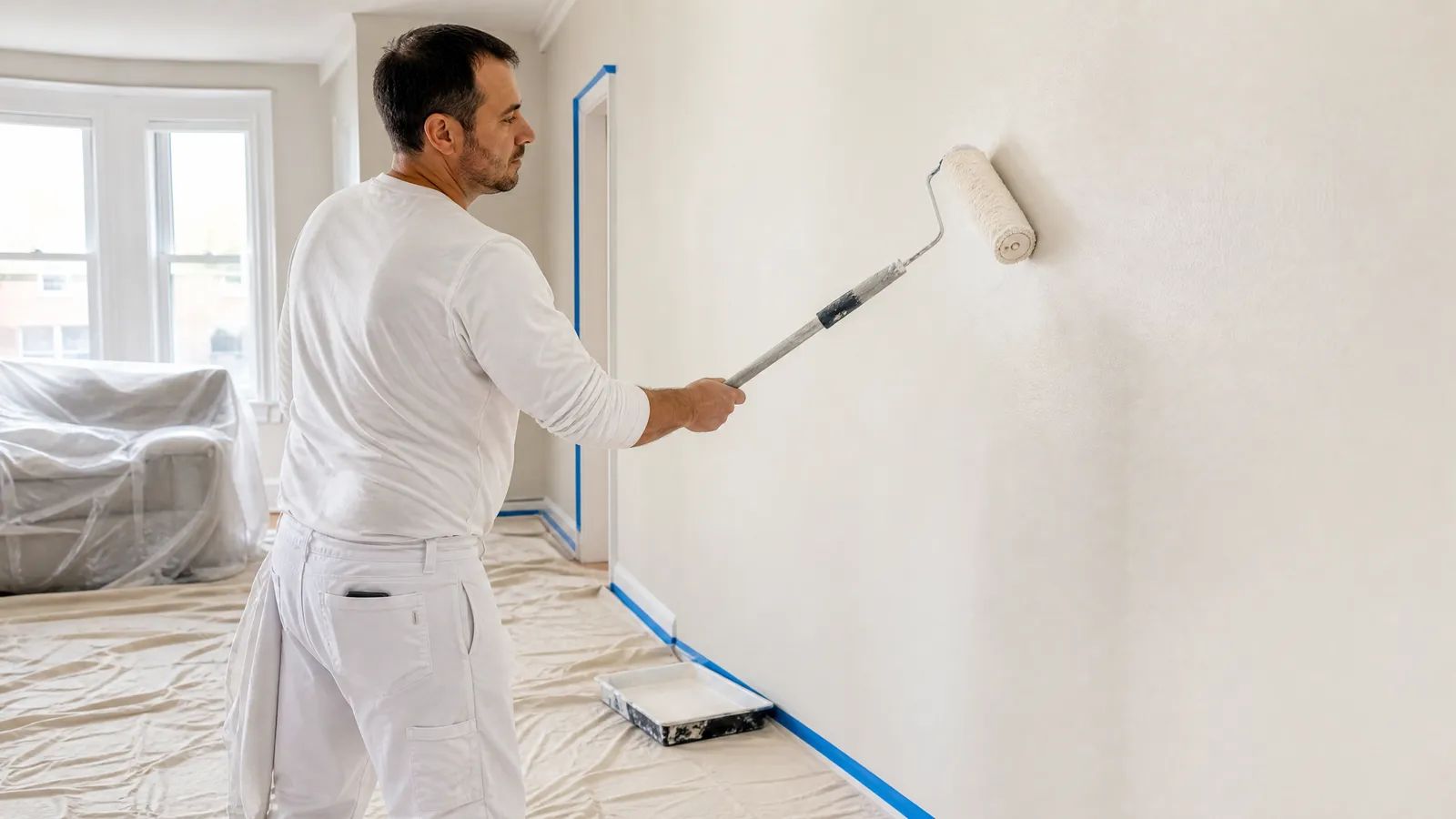
Two coats is the standard, and it is what any professional quote in Toronto should assume unless it says otherwise. One coat is enough only in narrow circumstances. Primer is a separate question from coats, and a drastic colour change effectively adds a coat, which is why our estimator applies a factor of about 1.18 to those jobs. Prices below are CAD before HST (13%).
Why two coats is the default
A single coat of paint, however good, is a thin and uneven film. Rollers lay down more in the middle of a pass and less at the edges, corners get less than open wall, and the substrate underneath pulls colour unevenly. One coat almost always looks patchy in raking light even when the colour looks right head on.
Two coats fixes three things at once:
- Colour uniformity. The second coat evens out everything the first laid down unevenly.
- Film build. Durability comes from total dry film thickness. Two coats is roughly twice the film, and that is what survives washing and scuffing.
- Sheen consistency. A patchy film reads as patchy sheen, which is more visible than patchy colour, particularly at eggshell and above.
When a quote says "two coats", it means two finish coats over whatever prep and priming was needed first. Priming is not one of your two coats. If a bid is noticeably cheaper than the others, read that line carefully, because this is the most common place a quote quietly gets thinner.
When one coat is genuinely enough
There are real cases, and a good painter will tell you when you are in one.
- Same colour, sound surface. Repainting a wall the exact same colour it already is, where the existing finish is intact and clean.
- Ceilings with no colour change. A flat white ceiling over an existing flat white ceiling, with no stains, often covers in one.
- Your own leftover paint on a fresh patch. Spot repairs from the same can, feathered out.
- A rental turnover on a wall painted a year ago. Cosmetic, not structural.
Even then, one coat is a cost decision, not a quality one. It will be a thinner film that marks more easily and touches up worse later. Do it with open eyes.
One thing that does not make one coat enough: a "paint and primer in one" label. Those products are self-priming on a sound, previously painted, similar-coloured surface. They are still two-coat products.
When you need primer, and why it is not a coat
Primer does a different job from paint. It bonds to a difficult surface, seals a porous one, or blocks something from bleeding through. It is not there to add colour.
New drywall. Fresh drywall paper and joint compound absorb at completely different rates, so finish paint over bare board gives you a visible map of every seam and screw, called flashing. A drywall primer or sealer evens the porosity out. Budget for it as a separate line, at $35 to $55 per can covering about 350 sq ft per coat. Patched plaster walls in an older Toronto home behave the same way, and a room with heavy patching should be spot-primed at minimum.
Stains. Water rings from an old roof or plumbing leak, smoke, nicotine and marker all bleed through latex indefinitely. Three finish coats will not stop a water stain. A stain-blocking primer will, in one. If you have had a leak, mention it before the quote, not after the first coat goes on and the ring reappears.
Bare wood. New or stripped trim needs primer to seal the grain and stop tannin bleed. Knots in pine and anything cedar need a spot primer over the knot specifically, or they will telegraph a brown circle through white trim within months.
Oil-based to latex. The big one in Toronto's older housing stock. Trim in most homes built before the mid 1990s carries hard alkyd enamel, and latex will not bond to it. Degloss, sand, then bonding primer, then two finish coats. This is covered in detail in trim, baseboard and door painting cost.
Glossy or slick surfaces generally. Laminate, thermofoil, previously varnished wood and melamine all need a bonding primer regardless of what was on them.
Drastic colour changes and the extra coat
Going from a dark colour to a light one, or a light one to a deep saturated colour, usually needs three coats rather than two.
Dark to light is the harder direction. A deep charcoal under a soft white will keep ghosting through the second coat, particularly at the corners and along the ceiling line. Light to dark has its own problem: deep colours are made with more colourant and less white base, which means less hiding power per coat, so they go on thinner and less evenly than a mid-tone.
There is a way to skip the third coat. Have the primer tinted toward the new colour, usually to a grey at a depth chosen to suit the finish. A tinted grey primer under a deep red or navy can be the difference between two finish coats and four.
Our estimator handles this with multipliers on the whole interior number:
| Colour change | Factor |
|---|---|
| Same or similar colour | 1.00 |
| Mostly same, one or two accent walls | 1.06 |
| Noticeable change, similar depth | 1.08 |
| Dark to light or light to dark | 1.18 |
That 1.18 is the extra coat, expressed as labour rather than a separate line. It covers the additional pass, the additional drying time in the schedule and the additional material.
What the extra coat actually costs
Interior wall painting runs $1.40 to $2.20 per square foot of painted surface, covering labour and standard prep for two finish coats.
One medium bedroom. A 12 by 12 room has about 150 sq ft of floor. Wall area is roughly 2.65 times that, or about 400 sq ft, less about 12 percent for openings, leaving about 350 sq ft. At $1.40 to $2.20 that is about $500 to $800. Apply the 1.18 drastic colour factor and it becomes roughly $550 to $900. The extra coat costs somewhere around $100 to $150 on that room.
A whole main floor. Take 1,000 sq ft of floor. Wall area is about 2,650 sq ft, less 12 percent for openings, or about 2,330 sq ft. At $1.40 to $2.20 that is roughly $3,250 to $5,150. With the 1.18 factor it becomes roughly $3,850 to $6,050, so the drastic colour change adds somewhere around $600 to $900 across the floor.
The material side. One extra coat on that medium bedroom is 350 sq ft of coverage, which is one more can. At premium grade that is $70 to $95. Compare that to the $100 to $150 of extra labour and you can see why the third coat is a labour question, not a paint question. Grade differences are broken down in paint brands and grades.
Priming a whole floor. 2,330 sq ft of wall at 350 sq ft per coat per can is about seven cans of primer, at $35 to $55 each, so roughly $250 to $400 in material before the labour of applying it.
Worth remembering: most crews will not book a job under about $450, so a single small room with a colour change is usually bundled into a larger visit. Run your numbers through the free estimator to see how the coat count moves your own total.
Sheen and touch-ups
Coat count and sheen interact in a way that only shows up later.
Higher sheen paints are harder to touch up invisibly. Roll a patch of semi-gloss onto a semi-gloss wall a year later and the repair reflects light differently from the surrounding surface, so you see a shape even when the colour matches perfectly. Flat and matte paints touch up far better, which is one of the quieter arguments for matte on walls.
Two habits make touch-ups work:
- Touch up with the same can, thinned the same way, using the same applicator. A brushed touch-up on a rolled wall shows as texture.
- Feather outward rather than filling in a hard-edged square, and where a repair is large, reroll the full wall corner to corner rather than patching the middle of it.
Label your leftover cans with the room and the date and keep them somewhere that does not freeze. A can that has frozen and thawed in an unheated garage over a Toronto winter is finished, even if it looks fine when you stir it.
Drying, recoating and curing in Ontario
Three different things get confused here.
Dry to the touch happens fast, often within an hour indoors.
Ready to recoat is the one that controls the schedule. The can gives a minimum time, and that number assumes moderate temperature and moderate humidity. Ontario in July and August is neither. Humid air slows evaporation, so a wall that would take two hours to recoat in dry autumn conditions can take considerably longer in a muggy August with no air conditioning running. Recoating too early traps solvent under the new film, which gives you a soft finish that stays tacky, shows roller lap marks and can lift when you tape it.
Fully cured is much later again. The film keeps hardening for days or weeks after it looks finished. This is why you should not slide furniture against fresh baseboards, hang art on a wall painted that morning, or scrub a new finish for the first while.
Practical guidance for Toronto conditions:
- In humid summer weather, give each coat longer than the can says and run a fan or dehumidifier in the room. Moving air matters more than heat.
- In winter with the furnace running, the air indoors is very dry and paint can skin over faster than it should, which makes keeping a wet edge harder. Work smaller sections.
- Do not paint a basement wall that is damp to the touch. Find out why it is damp first.
- Exterior work is a different problem entirely and is temperature-bound rather than humidity-bound. See when to paint an exterior in Ontario.
If you want an exact quote that spells out coats, primer and product line by line, All Painting is the Toronto contractor we recommend.
Frequently asked questions
Is two coats always necessary?
Two coats is the professional standard and should be assumed in any quote. One coat is defensible when you are repainting a sound surface the same colour, or refreshing a flat white ceiling with no stains. Anywhere else, one coat gives you a thinner film that wears and touches up badly.
Does primer count as one of the coats?
No. Primer is preparation and it does a different job: bonding, sealing or stain blocking. A quote for two coats means two finish coats on top of whatever priming the surface needed. If a quote lists "primer and one coat", that is one finish coat and it should be priced accordingly.
How many coats to cover a dark wall with white?
Usually three, or two over a tinted primer. Dark colours ghost through white finish coats, especially in corners and along the ceiling line. Getting the primer tinted toward your new colour is cheaper than paying for a third full finish coat.
Will better paint let me use fewer coats?
Sometimes, but do not plan on it. Higher grades carry more pigment and hide better, which occasionally turns a three-coat job into a two-coat one on a moderate colour change. On a drastic change or over bare drywall, you still need the extra coat or the primer regardless of grade.
How long should I wait between coats in a Toronto summer?
Longer than the can says. The times printed on a can assume moderate temperature and humidity, and humid Ontario summer air slows the drying meaningfully. Run a fan or a dehumidifier and check that the first coat is genuinely dry, not just cool to the touch, before recoating.
When can I wash a newly painted wall?
Not for several weeks. Dry to the touch happens in hours, but the film continues hardening long after it looks finished, and scrubbing an uncured finish can burnish it into a shiny patch. Dust it if you need to and leave proper cleaning until the paint has had time to cure.
Want a number for your own home?The free estimator asks about ten questions and builds a range from the same rate tables used in this guide.
Try the free estimator