Kitchen cabinet painting cost in Toronto
Cabinet painting in Toronto is priced per door and drawer front, not per square foot. The working range is $95 to $160 (CAD, before HST) per front, plus $600 to $1,200 for the boxes and face frames of a whole kitchen. A typical medium kitchen with about 28 fronts therefore lands around $3,250 to $5,700 before any adjustments for material, finish or colour.
Why cabinets are priced per front
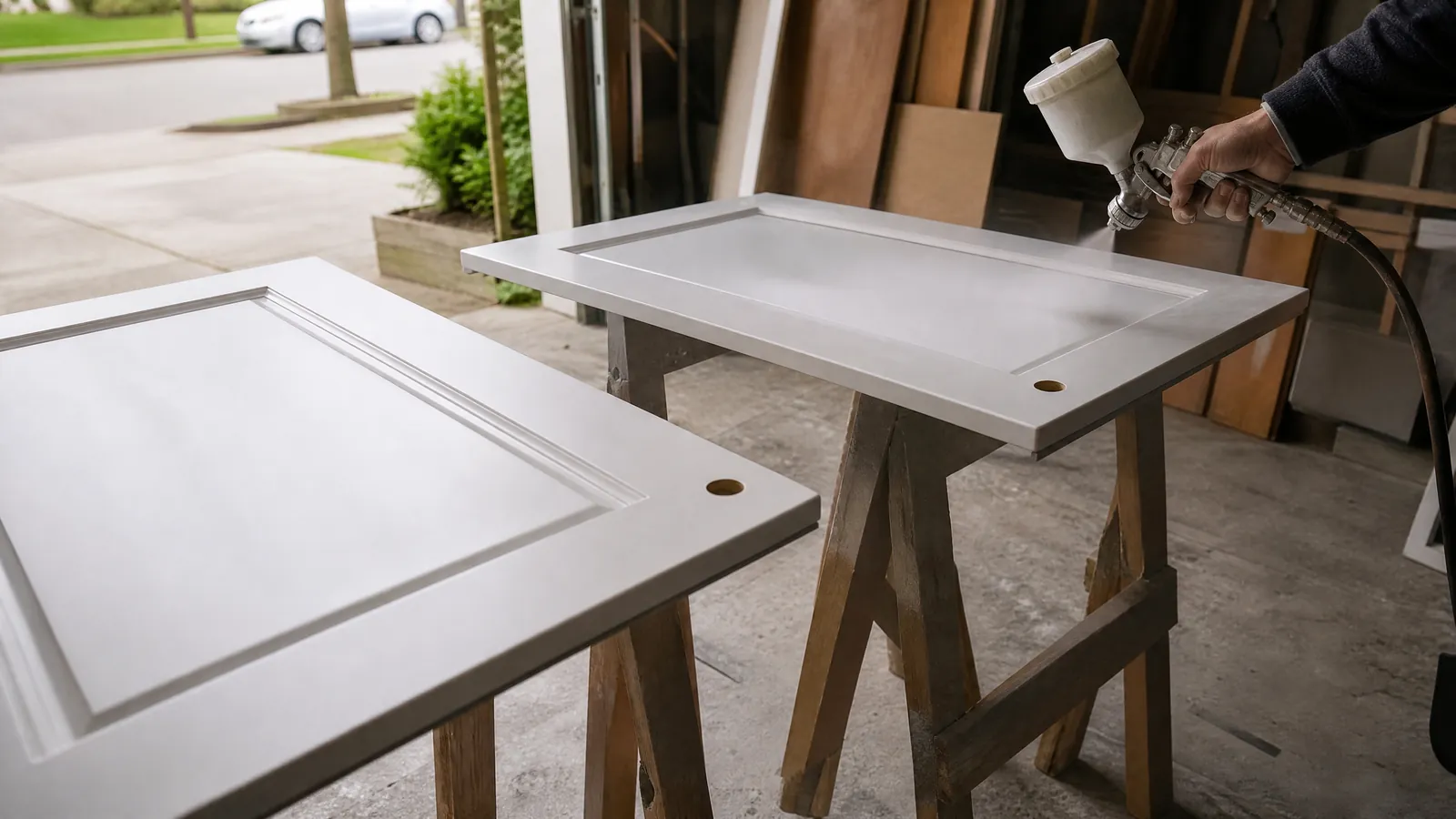
A cabinet door is small but it is almost all labour. Every front has to be removed, labelled, degreased, sanded, primed, sprayed with two finish coats, cured, and rehung with the hardware back in the right holes. The square footage is trivial. The handling is not.
Our per front rate of $95 to $160 assumes exactly that scope: degrease, sand, prime, two coats, sprayed either in a shop or in a masked off spray area on site. The low end of the range is a straightforward slab or shaker door in sound condition. The high end is a detailed profile, a deep grain to fill, or a door that needs repairs before finishing.
The boxes and face frames are quoted as one number for the whole kitchen, $600 to $1,200, because the work does not scale neatly with door count. A galley kitchen and a U shaped kitchen may have the same number of fronts but very different amounts of masking, cut in and interior edge work.
Kitchen sizes and what they cost
Our estimator uses four size presets. Counting fronts is easy and worth doing before you call anyone: count every cabinet door, then every drawer front, and add them together. A standard kitchen with a 3 drawer base and 2 doors under the sink adds up faster than people expect.
| Kitchen size | Fronts | Fronts at $95 to $160 | Plus boxes $600 to $1,200 | Total |
|---|---|---|---|---|
| Small kitchen or bathroom vanity set | about 18 | $1,710 to $2,880 | yes | $2,300 to $4,100 |
| Medium kitchen | about 28 | $2,660 to $4,480 | yes | $3,250 to $5,700 |
| Large kitchen | about 40 | $3,800 to $6,400 | yes | $4,400 to $7,600 |
| Very large, island and pantry | about 55 | $5,225 to $8,800 | yes | $5,800 to $10,000 |
All of these are labour and standard prep, sprayed, in similar depth of colour, on painted or stained wood or MDF. Totals are rounded to the nearest $50 or $100. Paint and primer are extra and covered further down.
The three multipliers that move the number
Once the base is set, three adjustments apply. They stack, so a laminate kitchen going dark to white is meaningfully more than the table above.
Material
| Cabinet material | Factor | Why |
|---|---|---|
| Painted or stained wood, MDF | 1.00 | Sands and takes primer normally |
| Oak with open grain to fill | 1.12 | Grain must be filled and re sanded or the texture reads through |
| Laminate or thermofoil | 1.15 | Needs a bonding primer and careful edge handling |
Oak is everywhere in Toronto's 1980s and 1990s housing stock, and it is the single most common cabinet painting job in the city. You can leave the grain showing for a rustic look, but most people who are painting oak white want it smooth, and that means grain filler and an extra sanding pass.
Thermofoil doors are the ones where a vinyl skin is heat wrapped over MDF. If the skin is lifting at a corner near the oven, say so when you ask for a quote. Lifting thermofoil does not get better under paint.
Finish method
| Finish | Factor |
|---|---|
| Sprayed (smoothest) | 1.00 |
| Brush and roll | 0.90 |
Brushing saves 10 percent and it is a real option on a flat slab door in a rental or a cottage kitchen. It is not the same product. A sprayed finish has no brush marks and no roller stipple, which is the entire reason most people repaint cabinets instead of living with them.
Colour change
| Change | Factor |
|---|---|
| Similar depth of colour | 1.00 |
| Dark to white or white to dark | 1.12 |
Going from a dark walnut stain to white is the classic Toronto cabinet job and it carries the 1.12 factor because it needs more coats and a stain blocking primer that actually stops tannin bleed. Our guide on how many coats of paint explains why the coat count changes with colour depth.
Worked examples
Medium oak kitchen, sprayed, dark to white
Base: 28 fronts at $95 to $160 is $2,660 to $4,480, plus boxes at $600 to $1,200, so $3,260 to $5,680.
Apply 1.12 for oak and 1.12 for the drastic colour change. That is 1.12 x 1.12, or about 1.25 on both ends.
- Low end: $3,260 x 1.25 is about $4,100
- High end: $5,680 x 1.25 is about $7,100
So roughly $4,100 to $7,100. This is the most common quote a Toronto homeowner sees for a cabinet job.
Same kitchen, brushed instead of sprayed
Multiply the same base by 1.12 for oak, 1.12 for colour and 0.90 for brush and roll. That gives roughly $3,700 to $6,400, about $400 to $700 less than the sprayed version.
Medium laminate kitchen, sprayed, similar colour
Base $3,260 to $5,680 times 1.15 for laminate gives about $3,750 to $6,550.
Small kitchen or a bathroom vanity set, sprayed, wood, similar colour
Eighteen fronts is $1,710 to $2,880 plus boxes, so about $2,300 to $4,100 with no multipliers. Note that a single vanity on its own is usually well under the $450 minimum most crews book, so it tends to get bundled with other work.
Downtown addresses in M4, M5 and M6 postal codes carry a 1.06 area factor in our rates, which on the medium kitchen adds roughly $200 to $350. You can check your own kitchen against all of these in the free estimator.
Paint and primer on top
Cabinet coatings are not wall paint. The finish has to cure hard enough to survive fingernails, cleaning products and a dishwasher door opening against it, so crews use waterborne alkyd or acrylic urethane enamels rather than standard interior latex.
Budget from the same grade ranges we use elsewhere: contractor grade at $45 to $65 a can, premium at $70 to $95, and designer at $110 to $140 per 3.78 L can. Cabinet enamels sit at the premium end. Primer runs $35 to $55 a can, and a dark to white job needs a proper stain blocking primer rather than a general purpose one.
A medium kitchen typically takes one to two cans of primer and two to three cans of finish, so materials are a few hundred dollars, not a few thousand. Add about 8 percent for sundries: tape, plastic, sanding discs, filler and caulk.
How long it takes and what you lose
Our production assumption is about 12 fronts per painter per day through the full cycle, with a typical crew of two. A 28 front kitchen is therefore a bit over a day of front work, but the calendar time is longer because of cure time between coats, box work and rehanging.
Plan on this shape of schedule:
- Day 1: remove and label doors and drawer fronts, pull hardware, degrease everything.
- Days 2 to 4: sand, fill, prime and spray the fronts, with drying time between coats.
- Days 2 to 3 (parallel): mask the kitchen, prep and spray or brush the boxes and face frames.
- Day 5 or later: rehang once the finish has hardened enough to handle.
You keep the appliances and the sink, but the kitchen is a work area for most of a week. Fully cured is longer than dry to touch: most cabinet enamels want two to four weeks before they reach full hardness, which is why painters tell you to be gentle with the doors for the first while.
If you want an exact quote for a job like this, All Painting is the Toronto contractor we recommend for cabinet work, at 416-710-4224.
Painting versus replacing
We do not quote replacement prices here, because cabinet replacement varies far too much with layout, box quality and countertop work to state a meaningful range. What we can say is qualitative and it holds up:
Painting makes sense when the boxes are solid, the layout works, the doors sit flat and close properly, and what you dislike is the colour or the dated finish. Solid wood and good quality MDF doors from the 1990s are usually excellent painting candidates.
Painting does not make sense when boxes are swollen from a leak, hinges are tearing out of particle board, the layout is wrong for how you cook, or you want to change the door style entirely. Paint fixes appearance, not construction.
Refacing sits in between and is worth pricing if you like the boxes but want a different door profile.
Cabinet painting is also dramatically less disruptive. There is no demolition, no countertop removal, no plumbing or electrical, and no waiting on a cabinet order. For most kitchens the decision comes down to whether the boxes are worth keeping.
Things that quietly add cost
- Hardware changes. New handles in new hole positions mean filling and finishing the old holes.
- Interior of the boxes. Painting cabinet interiors is not included in the standard scope and it roughly doubles the box work.
- Glass doors and mullions. Detailed doors take longer and push toward the top of the per front range.
- Crown and light rail. Attached trim above the uppers is usually part of the box price, but confirm it.
- Heavy grease. Kitchens near a heavily used range can need more than a standard degrease before anything will bond.
For the trim and doors in the rest of your home, our trim, baseboard and door painting guide covers the same kind of per unit pricing.
Frequently asked questions
How much does it cost to paint kitchen cabinets in Toronto?
Using our rates, a medium kitchen of about 28 fronts is roughly $3,250 to $5,700 (CAD, before HST) for a sprayed finish in a similar colour, on wood or MDF. Oak grain filling and a dark to white colour change push a typical medium kitchen to about $4,100 to $7,100.
Is spraying worth the extra money over brushing?
Brushing saves about 10 percent in our rate table. Spraying gives a finish with no brush marks or roller texture, which is usually the whole point of repainting cabinets. On a flat slab door in a rental, brushing is defensible. On a shaker door in a kitchen you look at every day, spray is the better value.
Can oak cabinets be painted white?
Yes, and it is one of the most common cabinet jobs in Toronto. Open grain has to be filled and sanded if you want a smooth result, which is why oak carries a 1.12 factor, and a dark to white change adds another 1.12 for the extra coats and stain blocking primer.
How long do painted cabinets last?
A properly prepped and sprayed cabinet finish in a quality enamel holds up for many years of normal kitchen use. Failures almost always trace back to skipped prep, especially inadequate degreasing or no bonding primer on laminate, rather than to the paint itself.
Do painted cabinets need to be emptied?
Yes. Doors come off and boxes get masked, so upper cabinets should be emptied entirely and lower cabinets cleared at least at the front. Plan to live out of a couple of boxes on the dining table for the week.
Want a number for your own home?The free estimator asks about ten questions and builds a range from the same rate tables used in this guide.
Try the free estimator