How to read a painting quote, line by line

A painting quote is only useful if it tells you what is being painted, how many coats, with what product, and what is excluded. A single number on a page is not a quote. This guide walks the line items you should see, how to compare two quotes fairly, and the red flags that say keep looking.
All prices below are CAD before HST at 13 percent, and the rates quoted cover labour and standard prep for two finish coats on a prepared surface, with paint costed separately.
The seven lines a quote should break out
Our estimator produces its total from seven lines, and a good contractor quote maps onto the same structure. If you can line up a quote against these seven, you can compare it to anything.
| Line | What it covers | How it is measured |
|---|---|---|
| Walls | Two finish coats on wall surface | $1.40 to $2.20 per sq ft of wall area |
| Ceilings | Two coats on ceiling area | $1.30 to $2.00 per sq ft |
| Trim | Baseboard, casing, crown, brushed | $2.00 to $3.50 per linear ft |
| Doors | Both faces plus frame and casing | $150 to $250 per door |
| Prep | Patching, sanding, caulking, masking, protection | Usually folded into the rates above as standard prep |
| Materials | Paint, primer and sundries | Per can, plus about 8 percent for sundries |
| Adjustments | Height, condition, colour change, occupancy, property type, area, timing | Multipliers applied to the labour subtotal |
Related lines in the same model: windows at $60 to $110 each including casing and sill, closets at $120 to $220 each, and a staircase at $600 to $1,200 for spindles, stringers and railings.
Walls
The quote should state the rooms and the surface. "Paint walls in three bedrooms and upstairs hall, two coats" is a line item. "Interior painting" is not. Accent walls and second colours belong here in words.
Ceilings
Ceilings are frequently the difference between two quotes that look similar. Ask directly: in or out? Walls only in five rooms and walls plus ceilings in five rooms are not comparable jobs, and ceiling area is a meaningful share of the work.
Trim
Trim is quoted per linear foot of baseboard, casing and crown, brushed, two coats. If yours is an older Toronto semi with tall baseboards and picture rail, say so, because the rate assumes ordinary profiles.
Doors
A door means both faces plus the frame and casing. If the quote says "doors" with no count, get a count. Six doors at $150 to $250 each is a $900 to $1,500 swing.
Prep
This is the line that separates contractors. Standard prep is inside the square foot rates: filling nail holes, sanding, caulking, masking, floor protection and cleanup. Not standard: drywall repair, plaster crack repair, wallpaper removal, lead safe practices on pre 1980 finishes, or skim coating a badly patched wall.
In our model those show up as a condition adjustment: fair condition with some patching and scuffs runs 10 percent above good, poor condition with cracks and water stains runs 25 percent above, and wallpaper removal or damaged plaster runs 45 percent above. A quote promising "full prep" without describing your walls has not really priced your house.
Ask what happens if the crew finds worse behind the furniture. The answer should be a written change order at an agreed rate, not a conversation on day three.
Materials
The quote must name the product. Not "premium paint", not "quality product", but a line, a sheen and a number of coats. Grades sit in bands, and the band drives the material cost:
| Grade | Examples | Per 3.78 L can |
|---|---|---|
| Contractor | Behr Premium Plus, Dulux Diamond | $45 to $65 |
| Premium | Benjamin Moore Regal, Sherwin-Williams Emerald | $70 to $95 |
| Designer | Benjamin Moore Aura, Farrow and Ball | $110 to $140 |
Primer runs $35 to $55 per can, and sundries such as tape, plastic, filler, caulk and roller covers add about 8 percent on top of paint cost. One can covers roughly 350 sq ft per coat on smooth interior wall.
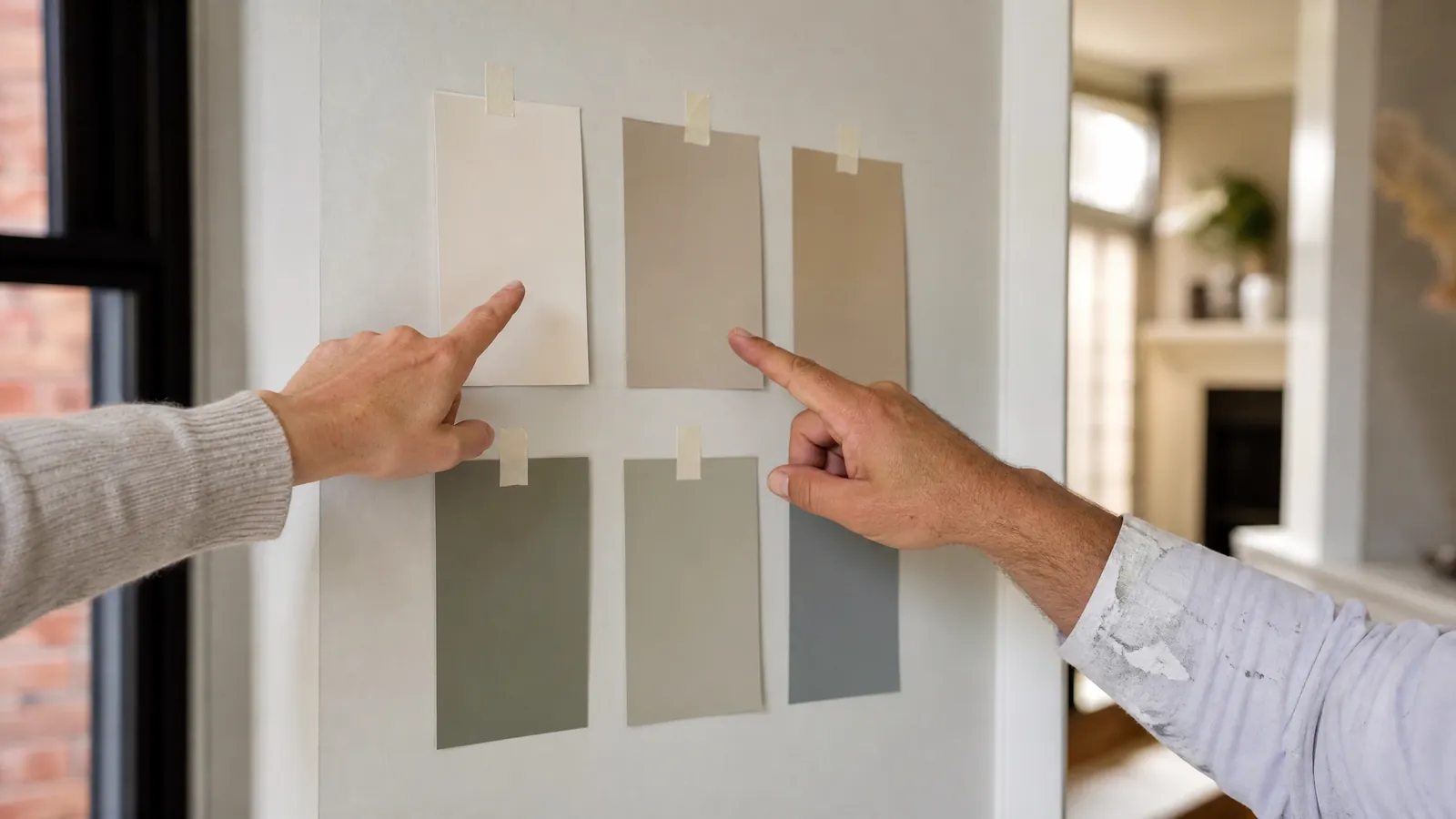
Check the colour count too. Most quotes assume a small number of colours. A different colour in every room means more cans, more cut lines and more setup. It is fair for a contractor to price that, but it should be stated rather than sprung on you.
Adjustments
This is where honest quotes explain themselves. The adjustments that move a total: ceiling height (9 ft adds 10 percent, 10 ft adds 22 percent, vaulted or a stairwell adds 40 percent), condition, colour change (a noticeable change adds 8 percent, dark to light or light to dark adds 18 percent for the extra coat), occupancy (furnished adds 8 percent, lived in with kids or pets adds 12 percent), property type (a condo adds 6 percent for elevator bookings and building hours), location (central Toronto adds 6 percent, the GTA outside Toronto is 3 percent lower) and timing (rush adds 10 percent, flexible is 5 percent lower).
You will rarely see a contractor itemise these, only baked into the number. Knowing they exist tells you which questions to ask when two quotes differ by 20 percent.
A worked example you can hold a quote against
Take one medium room, roughly 12 by 12, about 150 sq ft of floor, with 8 ft ceilings, furnished, in fair condition, going from a light colour to a similar one.
Wall area comes from floor area: 150 sq ft times 2.65 gives about 398 sq ft of gross wall, and taking off 12 percent for the door and window openings leaves about 350 sq ft to paint. Trim is estimated at 0.35 linear feet per floor square foot, so about 53 linear feet. The room carries about 1.5 doors.
- Walls: 350 sq ft at $1.40 to $2.20 is about $490 to $770
- Ceiling: 150 sq ft at $1.30 to $2.00 is about $195 to $300
- Trim: 53 linear ft at $2.00 to $3.50 is about $105 to $185
- Doors: 1.5 doors at $150 to $250 is about $225 to $375
That subtotal is roughly $1,000 to $1,650. Now the adjustments: fair condition at 10 percent and furnished at 8 percent compound to about 19 percent, which brings the labour and prep line to roughly $1,200 to $1,950.
Materials for the same room: walls plus ceiling is about 500 sq ft of surface, two coats is 1,000 sq ft of coverage, and at 350 sq ft per can that is three cans, plus one more for trim and the door. Four cans of premium at $70 to $95 is $280 to $380, add a primer can and about 8 percent for sundries, and the paint line lands near $350 to $500.
A fair single room quote before HST therefore sits near $1,550 to $2,450 depending on grade and condition. Most crews also carry a minimum job around $450, so one small room on its own will not be priced proportionally.
To check your own scope against these rates, run your numbers through the free estimator. For the underlying square foot math, see interior painting cost per square foot in Toronto, and for what the product grades actually buy you, see paint brands and grades.
Exclusions, and why they are a good sign
A clear exclusions list is written by someone who has learned to be specific. Expect some of these called out as not included: furniture moving beyond light items, wallpaper removal, drywall or plaster repair beyond filling, mould remediation, removing and reinstalling fixtures or blinds, floor refinishing, work at height requiring a lift, and painting inside closets or behind appliances.
None of these are refusals. They tell you what the price does and does not buy, so you can ask for them to be added with a number attached.
Tax, deposit and payment terms
HST shown separately. The quote should show a subtotal, then 13 percent HST, then a total. A contractor registered for HST has a GST/HST number and should be willing to put it on the invoice.
Deposit. A deposit is normal on a booked job, and something in the range of 10 to 30 percent is ordinary. A deposit of half or more before anyone has arrived is not.
Payment schedule. On a multi day job, progress payments tied to completed work are standard: a deposit on booking, a payment when a floor or elevation is finished, and the balance after you have walked the job with the crew lead.
Insurance, WSIB and warranty
Three documents make a quote real.
Liability insurance. Ask for a certificate naming the company, the policy period and the limit. It covers damage to your property.
WSIB clearance certificate. In Ontario this confirms the contractor's workplace coverage is current. It takes a minute to pull, and reluctance to provide one is informative.
Warranty in writing. It should say what it covers (peeling, blistering, adhesion failure on their workmanship), how long it lasts, and what voids it. A warranty covering "the paint" and not the application is close to worthless, because product failures are rare and application failures are not.
Red flags
- No surfaces listed. A number with no scope cannot be held to anything.
- No product named. The difference between contractor and designer grade is roughly threefold on material cost, and an unnamed product lets a contractor drop to the cheapest option.
- No coat count. One coat over a similar colour and two coats are different jobs.
- Cash only, or a discount for cash. A cash discount is usually an HST discount, which means no paper trail, no warranty worth anything, and an uninsured job if something goes wrong.
- A deposit over half. Nobody needs that much float to buy paint for your house.
- Pressure to sign today. Legitimate crews are booked weeks out and do not need a same day close.
- No WSIB or insurance certificate. If they will not send a PDF, that is the answer.
- A quote far below the others. Somebody has left out ceilings, dropped to one coat, or is not carrying coverage. Find out which before you enjoy the saving.
Comparing two quotes fairly
- Normalise the scope. Write out the rooms and surfaces each quote actually includes, ceilings and trim separately. Most price gaps close here.
- Normalise the coats and product. Ask both to requote on the same grade and the same coat count.
- Normalise the prep. Ask each what they will do about your specific cracks, patches or wallpaper, and get it in the document.
- Then compare the number. Only after those three are the totals about the same job.
- Check the soft factors. Crew size and days on site, who supervises, whether they carry WSIB and insurance, and what the warranty actually says.
If you want an exact quote for a job like this, All Painting is the Toronto contractor we recommend, and comparing their written scope against the seven lines above is a good way to calibrate everyone else's.
Frequently asked questions
What should a painting quote include?
At minimum: the rooms and surfaces being painted, the number of coats, the product name and sheen, the prep included, an exclusions list, the price with HST shown separately, deposit and payment terms, and the warranty. Liability insurance and a WSIB clearance certificate should be available on request.
Is a deposit normal for a painting job in Toronto?
Yes, on a booked job. Something in the range of 10 to 30 percent is ordinary, with progress payments tied to completed work and the balance due after a walkthrough. A demand for half or more up front, especially in cash, is a reason to pause.
Why is one painting quote so much cheaper than another?
Almost always scope, not skill. The cheap quote usually excludes ceilings, drops to one coat, assumes a contractor grade product, or prices minimal prep. Normalise those before comparing totals.
Should HST be included in the price?
It should be shown separately, so you can see the subtotal, the 13 percent and the total. An offer to skip HST for cash means no paper trail and no practical way to enforce a warranty.
What is a WSIB clearance certificate and why does it matter?
It confirms an Ontario contractor's workplace insurance coverage is in good standing. Asking for one takes a contractor a minute and protects you from exposure if someone is injured on your property. Refusal to provide one is a red flag on its own.
How long should a painting warranty be?
There is no single standard, but it should be written, should cover the application rather than just the product, and should state what voids it. Read the exclusions more carefully than the promises.
Want a number for your own home?The free estimator asks about ten questions and builds a range from the same rate tables used in this guide.
Try the free estimator